
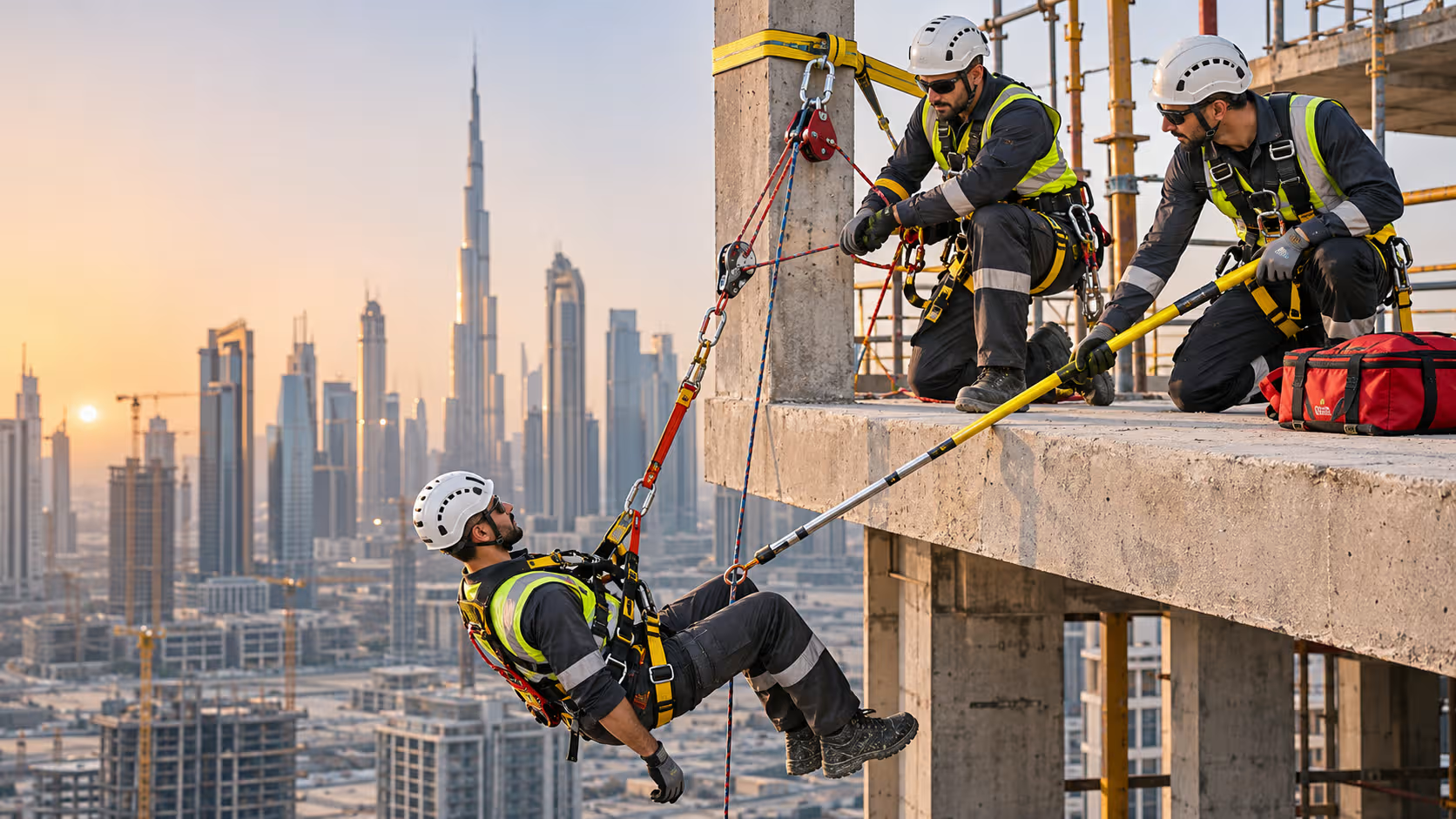
Working at height remains one of the highest-risk activities across construction, utilities, telecommunications, industrial maintenance, and infrastructure sectors. While fall prevention systems reduce risk, emergency preparedness is what ultimately saves lives. A suspended worker must be rescued quickly and safely to prevent suspension trauma, secondary injury, or fatal outcomes.
This is where a properly selected rescue kit, compatible PPE, and a pre-engineered rescue system become critical components of any height safety strategy.
Why Rescue Planning Is Essential in Work-at-Height Operations
Fall arrest systems are designed to stop a fall, not to complete the rescue. Once a worker is suspended:
- Time becomes critical
- Blood circulation may be compromised
- Self-rescue may not be possible
- Access to the casualty may be limited
A structured rescue plan must include:
- Pre-installed or deployable rescue devices
- Trained personnel
- Clearly defined anchor points
- Controlled descent capability
- Adequate rope length and mechanical advantage
A modern rescue system allows the rescuer to attach, raise, and lower a casualty without directly accessing them, dramatically reducing secondary risk.
Core Components of a Rescue Kit
A professional-grade rescue kit designed for height emergencies typically includes:
- Anchor sling
- Pulleys (single or double depending on configuration)
- Controlled descent device
- Rescue rope (pre-measured for required lowering distance)
- Telescopic pole for remote attachment
- Connectors and locking carabiners
- Storage bag for rapid deployment
An effective system must allow a rescuer to:
- Attach to a suspended casualty
- Raise the casualty to release their fall arrest lanyard
- Raise or lower the casualty to a point of safety
Importantly, this process can be completed without the rescuer needing direct access to the casualty, provided they can access the original anchor point.
High Anchor vs. Low Anchor Rescue Configurations
An often-overlooked technical detail in rescue planning is anchor height. The mechanical advantage of the system changes depending on whether the anchor is above or at foot level.
High Anchor (Above 1.5m)
When the anchor point is positioned above the rescuer’s foot level:
- The rescuer can use body weight to assist the lift
- Mechanical advantage is approximately 3:1
- The casualty may be raised back toward their original working level
This configuration reduces physical effort and improves control.
Low Anchor (Foot Level)
If the anchor is at foot level:
- The rescuer must rely more on physical strength
- Mechanical advantage increases (around 4:1)
- The casualty must be raised just enough to release their lanyard and then lowered
The correct configuration determines both efficiency and safety of the operation.
Controlled Descent and Load Management
A critical function of any rescue device is ensuring controlled descent during an emergency operation. Once the casualty’s weight has been safely transferred onto the rescue line, the rescuer must manage the lowering process using a controlled braking device. The descent must remain smooth, stable, and fully adjustable to prevent sudden drops or additional injury. Proper rope length planning is equally essential: in most lowering scenarios, the rope should be approximately four times the vertical distance to the intended point of safety. Failure to calculate and prepare adequate rope length can compromise the effectiveness of a rescue kit and may delay or prevent a successful rescue.
Inspection, Maintenance, and PPE Integration
| Area | Essential Requirements |
|---|---|
| Inspection | Check before every use; periodic inspection by a competent person; remove from service after shock load |
| Hardware | Inspect metal parts for damage/corrosion; ensure connectors lock properly |
| Rope | Look for abrasion, cuts, sheath damage, or diameter reduction |
| Storage | Keep in dry, cool area; protect from sharp edges, chemicals, and direct heat |
| PPE Compatibility | Full body harness (front attachment), certified connectors, fall arrest lanyard, helmet, protective gloves |
Types of Rescue Systems for Different Applications
Different environments require specialized systems:
Fixed Ladder Rescue System
Designed for vertical access systems such as tanks, silos, and telecom towers. These are often pre-installed to enable rapid rescue without delay. See the Gotcha CRD ladder rescue system.
Pre-packed High Access Kits
Systems such as the Gotcha Shark high access rescue kit are designed for complex high-structure environments requiring extended reach and mechanical efficiency.
Compact Rescue Solutions
Portable systems like the Gotcha 2 rescue kit are ideal for general construction and maintenance applications.
Each system should be selected based on:
- Maximum working height
- User weight capacity
- Required mechanical advantage
- Deployment speed
- Training level of personnel
Best Practices for Work-at-Height Rescue Preparedness
To ensure full compliance and safety:
- Conduct rescue drills regularly
- Assign trained rescue personnel
- Pre-identify anchor points
- Verify rope length vs working height
- Store kits in easily accessible locations
- Document inspections and servicing
Rescue planning should never be improvised. It must be engineered.
Conclusion
A well-designed rescue kit, integrated with certified PPE and a properly engineered rescue system, is not optional in work-at-height operations. It is an ethical and operational necessity.
Advanced rescue devices enable:
- Remote casualty attachment
- Controlled raising and lowering
- Reduced rescuer exposure
- Faster emergency response
Organizations that invest in structured rescue planning significantly reduce the severity of fall incidents and improve survival outcomes. Height safety does not end with fall arrest. It ends with safe recovery.
At TSS, under the banner of Safe Working Solutions, Working At Height Specialists, we provide comprehensive products, services, and engineered solutions for working-at-height environments. From professional rescue kits and fixed ladder rescue systems to complete safety assessments and implementation strategies, we support organizations in building reliable, compliant, and efficient emergency response frameworks.
FAQ
1. Why is a rescue kit necessary if fall arrest systems are already in place?
Fall arrest systems stop a fall but do not bring the worker back to safety. A rescue kit enables controlled retrieval of a suspended worker, preventing suspension trauma and additional injury.
2. What determines the type of rescue system required?
Working height, anchor location, access limitations, weight capacity, and site-specific risk assessments determine which rescue system is appropriate.
3. How often should rescue devices be inspected?
Rescue devices must be inspected before every use and periodically by a competent person according to regulatory and manufacturer guidance.
4. Can a single person perform a height rescue?
Certain engineered rescue systems allow a single trained rescuer to safely raise and lower a casualty without direct access, depending on site conditions.
5. What is the most critical factor in height emergency rescue?
Time. Rapid deployment of a properly configured rescue kit and trained personnel significantly improves survival outcomes.