
Roof Safety System
TSS Roof Safety System is designed to provide safety for workers on the roof and prevent major causes of accidents from the roof. As roofs require safety for maintenance, inspection, and repair, it is critical to select the right roof safety systems.
Our roof safety systems are categorized into Temporary lifeline systems and Permanent lifeline systems, Temporary lifeline systems, Guardrail systems, skylight protection, roof walkway systems, and walkway mat.
Our designs for rooftop systems provide safe access on the roof whilst preventing and arresting falls around service equipment and parapet edges. All of the abovementioned systems are manufactured and tested in compliance with relevant EN standards, installed and supplied with Warranties and Liability insurance cover, giving the customer peace of mind.
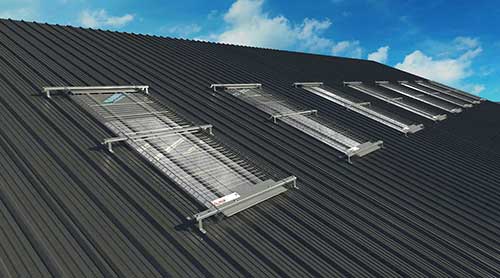
Skylight Protection

Roof Walkway System

TSS Guardrails

Temporary Lifeline Systems

Walkway Mat
create durable, high-visibility paths for safer, more efficient movement across construction sites
Roof edge protection systems
Roof edge protection prevents falls at open perimeters. Systems are designed to create a continuous physical barrier using guardrails, mesh panels, and toe-boards without penetrating the roof membrane.
Advantages:
- Collective protection for multiple workers
- Quick installation without structural drilling
- Compatible with parapet, standing seam, or flat roofs
Roof fall protection systems
Roof fall protection focuses on arresting or restraining a person’s fall rather than preventing access. These systems include lifelines, anchor points, and harness attachments.
Typical applications:
- Maintenance of skylights, HVAC, or solar panels
- Access across fragile roof surfaces
- Long-span roofs requiring travel restraint systems
Temporary roof safety systems
Temporary systems are used during construction, renovation, or short-term maintenance. They provide flexibility and can be moved from one site to another.
Key features:
- Lightweight, modular, and reusable
- Fast setup and dismantling
- Suitable for short-duration roof works or façade projects
Permanent roof safety system
Permanent solutions are integrated into the structure to provide ongoing access and maintenance safety. Common systems include fixed guardrails, cable lifelines, skylight protection and access walkways.
Benefits:
- Long-term compliance with safety regulations
- Minimal maintenance after installation
- Ideal for industrial buildings, warehouses, and solar plants
What Are Roof Safety Systems and When Are They Needed?
Roof safety systems are essential whenever workers operate near unprotected edges, fragile surfaces, or elevated areas. They ensure compliance with fall protection standards (EN 13374, EN 795) and reduce liability and downtime from safety incidents.
Differences Between Roof Edge Protection, Roof Fall Protection & Temporary Roof Safety
- Roof Edge Protection: Prevents access to hazards (collective protection)
- Roof Fall Protection: Stops a fall in progress (individual protection)
- Temporary Systems: Provide flexible, short-term coverage during active construction
Each type can be combined depending on project phase and risk profile.
Key Features of Effective Roof Safety Systems (Materials, Standards, Installation)
- Materials: Galvanized or stainless steel, aluminium, or high-grade polymer components
- Compliance: Certified to EN 13374 (edge protection) and EN 795 (anchor devices)
- Installation: Non-penetrating clamps or counterweighted bases to preserve roof membranes
- Inspection: Regular visual and load testing ensures ongoing performance
Choosing Between Temporary and Permanent Roof Safety Systems
When selecting a system, consider:
- Project duration: Short-term works → temporary; long-term maintenance → permanent
- Roof type: Flat, pitched, or metal profile
- Maintenance frequency: High-frequency → fixed guardrails; low-frequency → lifeline anchors
- Budget & reuse potential: Temporary systems reduce upfront cost
- Maintenance Team: How many workers are required to access the roof.
Roof Safety Solutions for Construction Projects in the Middle East
TSS designs roof safety systems engineered for regional climate challenges—UV exposure, sand, and wind load. All products comply with EN standards and are field-tested for high durability.
Features:
- UV-resistant coatings
- Stainless Steel or Hot-dip galvanised finishes
- Wind-load rated up to 1.2 kN/m
- Local installation support and inspection services
Installation, Inspection & Maintenance of Roof Safety Systems
Installation process:
- Roof survey and hazard identification
- Selection of a suitable protection type
- Certified installation per manufacturer guidelines
- Documentation and sign-off
Maintenance plan:
- Visual inspections every 6 months
- Load tests annually
- Replacement of worn anchors or fasteners
Roof Safety Systems Services Across the Middle East
We deliver certified roof safety system design, installation, and inspection services throughout the Middle East, including the UAE, Saudi Arabia, Kuwait, Bahrain, Oman, and Qatar.
All systems comply with EN 13374 and EN 795 standards and are engineered to perform reliably under regional conditions such as extreme heat, UV exposure, and high wind loads.
Comparison Table: Roof Safety Solutions
System Type | Use Case | Installation | Certification | Lifespan | Notes |
Temporary Guardrail | Construction & renovation | Counterweight / clamp | EN 13374 Class A | 5–7 years | Fast setup, reusable |
Fixed Lifeline System | Maintenance / access | Anchored to roof structure | EN 795 C/D | 10+ years | Ideal for permanent roofs |
Roof Walkway with Guardrail | Continuous access | Bolted / integrated | EN 13374 + EN ISO 14122 | 10+ years | Prevents surface damage |
Mobile Roof Edge Barriers | Short-term protection | Freestanding base | EN 13374 | 3–5 years | Portable, non-penetrating |