
Edge Protection Systems
We use a temporary edge protection system as the first line of defense to secure the open edges in construction sites and buildings to prevent the fall of workers or objects from height. TSS provides Meshguard©, shaftgate©, Coreguard© as edge protection systems.
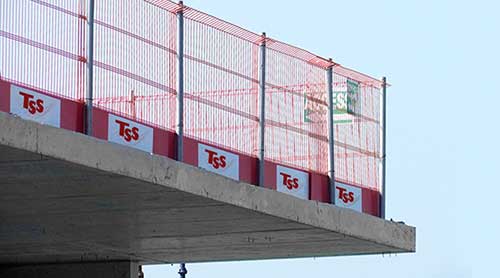
TSS Meshguard© System utilizes steel mesh barriers to protect the open edges on
concrete, steel, and timber structures. With its industry-established connection detail, Meshguard delivers a speedy assembly with economy and safety in mind.
TSS edge protection system meets all necessary safety standards in this region and industry and beyond. TSS Edge Protection systems are fully compliant with EN 13374 class A and B.
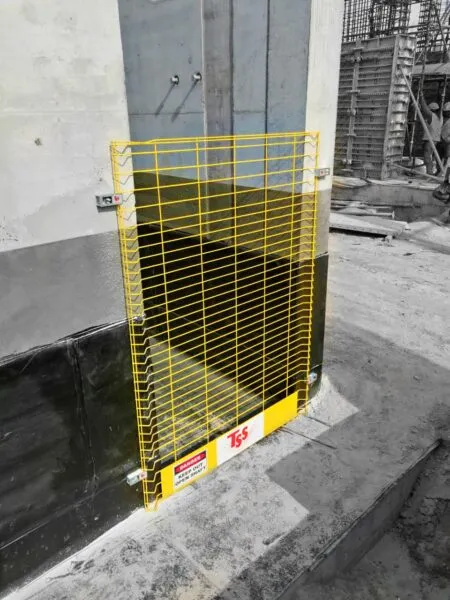
TSS Shaftgate is an adjustable gate that protects the open edges of Staircase Cores and Lifts shafts. TSS Coreguard is a fixed protection steel mesh that protects the open edges of Staircase Cores and Lifts shafts.
These are an important element in fall protection on sites. These openings are subject to restrictive access control measures for sub-contractors who need access to the shafts.

Meshguard
provides fast, durable edge protection for safe work at height, meeting EN13374 A/B standards

Shaftgate
provides quick protection for staircase and lift shaft openings, controlling safe access for all on
Coreguard
fixed steel mesh system that protects open stair and lift shaft edges, enhancing essential site fall safety
Ladstair
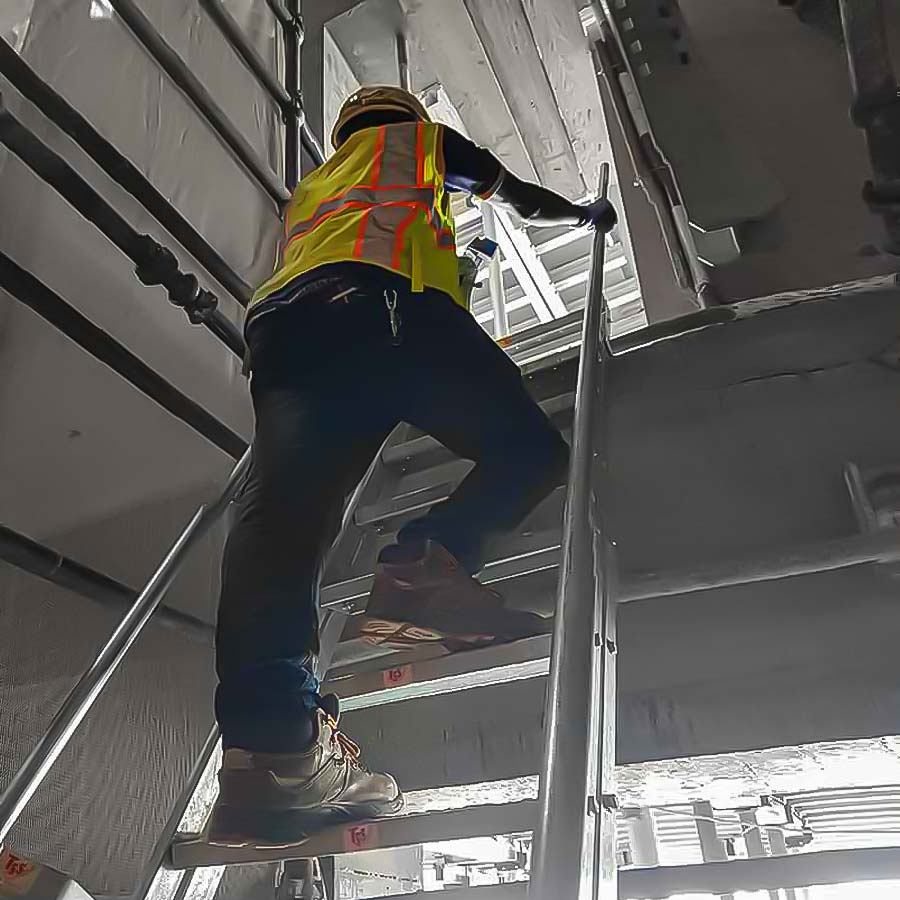
Ladstair is an adjustable stair-ladder with handrails, usable on slabs or scaffolds within a wide angle range
Edge protection
Edge protection prevents falls at exposed edges such as slabs, roofs, stair cores, and open perimeters. Systems are engineered for rapid installation, consistent load performance, and durability on busy sites.
Why it matters
- Reduces fall-from-height risk across active work zones
- Improves productivity by enabling safe access near edges
- Helps demonstrate compliance during audits and inspections
Safety edge protection
Safety edge protection combines uprights, posts, and infill panels (mesh/rails) anchored to concrete, steel, timber, or slab edges. Choose configurations based on substrate, live loads, wind exposure, and build sequence.
Key selection factors
- Anchor type & spacing (cast-in, clamp, screw)
- Infill style (mesh panel vs. twin-rail) and toe-board options
- Reusability, transport, and on-site adjustability
Edge protection barriers
Edge protection barriers provide collective protection for workers and materials. They can integrate debris mesh or toe-boards to stop tools and small parts from falling.
Typical use cases
- Slab and balcony perimeters
- Stair openings and lift shafts
- Roof edges, podiums, and bridge decks
Edge protection construction
For construction environments, systems must balance strength, speed, and flexibility. Modular components allow phasing with the build schedule and quick reconfiguration between zones.
Contractor checklist
- Verified load/deflection performance with documentation
- Compatibility with formwork/scaffolds and MEP penetrations
- Clear inspection & maintenance plan throughout the project
Temporary edge protection
Temporary edge protection (TEP) is installed during construction and removed at handover. It supports dynamic site conditions without permanent alterations to the structure.
Advantages
- Fast install/removal with minimal tools
- Adjustable to irregular geometries
- Cost-effective versus custom fabrications
How Edge Protection Systems Work on Construction Sites
Edge protection creates a continuous physical barrier at fall hazards. Posts are fixed at specified centres; panels/rails attach to posts; toe-boards close gaps at foot level. Inspections verify anchor integrity, panel engagement, and height consistency.
Key Features and Components of Edge Protection
- Posts & bases: galvanised steel/aluminium, adjustable heights
- Anchors & clamps: substrate-specific (concrete/steel/timber)
- Infill panels/rails: mesh panels or twin-rail with integrated toe-board
- Gates & access points: self-closing options for stair/lift openings
- Wind bracing: required on exposed elevations and high-rise sites
Benefits of Using Edge Protection Barriers
- Collective protection for multiple workers simultaneously
- Reduced downtime from safety stoppages and incidents
- Cleaner perimeters with debris containment options
- Supports compliance with temporary edge protection standards
TSS edge protection installation services
Our specialists handle surveying, design selection, installation, inspections, and maintenance—coordinating with your programme to minimise disruption.
Service scope
- Site survey & hazard mapping
- System design & anchor specification
- Certified installation and sign-off
- Routine inspections & documentation
- Dismantling and redeployment
Edge Protection Services Across the Middle East
We proudly deliver our edge protection systems and installation services across the Middle East, covering the UAE, Saudi Arabia, Kuwait, Bahrain, Oman, and Qatar.
Our regional teams provide full project support — from site assessment and system design to certified installation, inspection, and maintenance, ensuring full compliance with EN 13374 (class A and B) standards and local safety regulations.
Regional service highlights:
- Certified edge protection installation teams across the GCC
- Fast delivery and on-site supervision in high-rise and infrastructure projects
- Flexible modular systems for façades, roofs, and bridge works
- Ongoing inspection and maintenance support for long-term safety assurance
Comparison Table: Edge Protection Options
| System Type | Best For | Infill | Typical Anchor | Post Centers | Notes |
| Mesh Panel Barrier | Perimeters & balconies | Welded mesh + toe-board | Slab clamp / cast-in | 1.2–2.4 m | High debris containment |
| Twin-Rail Guardrail | Rapid internal edges | Upper & mid rail + toe-board | Screw anchor/steel clamp | 1.8–2.4 m | Lightweight, fast install |
| Shaft Opening Gate | Lift/stair cores | Gate + rails/mesh | Concrete screw/bracket | N/A | Self-closing, lockable |
| Roof Edge Protection | Roof works & parapets | Mesh or rail with toe-board | Parapet clamp / counter-weight | 1.5–2.0 m | Enhanced wind bracing |
Deciding between fall prevention and fall protection equipment?
Fall prevention systems and equipment are designed to prevent the fall of a person or objects from height. Handrailing, Guard railing, or temporary edge protection systems are typical examples of everyday use of Fall Prevention.
Fall Protection Systems and equipment on the other hand are designed to minimize the consequence of a fall of a person or objects from height thereby protecting the worker from severe injury or fatality. Good examples of such equipment for fall arrest systems are Safety Nets, Safety Net Fans, temporary lifelines, Permanent lifelines, Restraint systems, or Harness and Lanyard systems. Mobile Elevated working platforms (MEWP), movable working platforms, or Scaffolds can also be classed as Fall Protection Equipment.
FAQ
Where is edge protection system required?
What is Meshguard and where is it required?
What is the difference between shaft gate and coreguard?
Shaftgate

Coreguard

Temporary Edge Protection Standards EN13374 ?
The European standard EN13374 defines and outlines the use of temporary edge protection to be used on construction and building sites. This standard specifies the material, appearance, performance, and the necessary markings on such systems.
EN 13374 outlines requirements for three classes of the edge protection systems.
Class A 0-10° roof pitch
Class B 10-30° roof pitch
Class C 30-45° roof pitch
All classes have a static load requirement to be applied perpendicular, horizontal and vertical. Class B & C also have a dynamic load requirement applied, representing a worker or material rolling down the roof slope and impacting the edge protection system.
What are the different types of Edge Protection
In accordance with EN 13374, edge protection systems are designed for 3 Classes depending on the slope and use. Each system is designed with a certain application in mind, the most popular of which are :
1. Tubular Guardrail solutions.
2. Mesh Barrier Systems.
3. Counterweight systems.
4. Full enclosure or vertical screen.
5. Net type edge protection.
1. Tubular Guardrail solutions
Tubular guardrail edge protection is the traditional solution using 48.3 Dia or 42 Dia tubes and fittings. This method incorporates a 1.0m or higher post, main handrail, an intermediate handrail, and a toe board (usually with a 225mm (9″) scaffold board) connected using scaffold fittings.
Tubular guardrail systems are generally designed to class A with only static loading taken into account for designs. Some countries specify a triple handrail for additional safety and use debris netting for the better enclosure.
2. Mesh Barrier Systems
Mesh barrier systems utilize a pre-designed steel mesh to protect the open edges on concrete, steel, and timber structures with proprietary connection details and a welded integral steel toeboard. Mesh barriers deliver a speedy assembly with better containment, economy, and safety in mind.
3. Counterweight systems
freestanding, counterweight temporary edge protection solutions are freestanding, used on existing roofs during the maintenance or refurbishment. Free-standing weighted edge protection systems are designed to comply with the Class A requirements of BS EN 13374 but are based on different supporting principles to fixed mesh barrier systems.
4. Full enclosure or vertical screen
These applications are beyond BS EN 13374. Such configurations or systems will typically fill the edge protection space including and above 1.0m, at varying heights up to the soffit. These arrangements are different
from standard BS EN 13374 installations due to the increased forces (mainly wind loadings) that result.
The typical applications encountered will be where there is an increased hazard affecting pedestrian traffic, for high rise/multi-story buildings, and generally where a safety policy applies to a client /contractor/project.
5. Net type edge protection
They are specifically designed for clamping to steelwork sections usually at full height roof level but can also be used at intermediate floor levels.
They would normally incorporate aluminum or steel tube/lattice beams to
form a guardrail or safety nets as additional fall protection.
Safety nets and/or debris nets can be attached to the system to give additional protection for roof workers and to prevent objects falling from the roof but the system must be tested for this purpose.
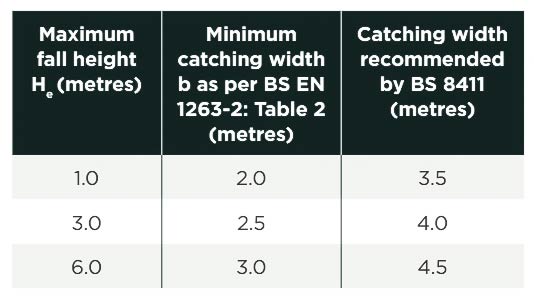
If the netting is to be used for fall arrest purposes, safety netting which is compliant with EN 1263-2 must be specified. Debris netting should be assessed for wind loading on the guardrail structure.
Can the same system be used on concrete and steel edges?
Are edge protection services available in the Middle East?
Yes — our certified edge protection systems and installation teams operate across the UAE, Saudi Arabia, Kuwait, Bahrain, Oman, and Qatar. We provide full design, supply, installation, and inspection services in compliance with EN 13374 (class A and B) standards, adapted for the region’s climate and construction requirements